



A red notice in Brazil is a request from another country to locate and provisionally arrest a person, not an arrest warrant that operates on its own. Under Brazil's Migration Law (Lei 13.445/2017), a foreign national is detained only after a Brazilian judicial decision, and the requesting State then has 60 days to formalise the extradition request.
If your name appears on an Interpol alert and you live, work or travel in Brazil, the question that matters is narrow: what can Brazilian authorities actually do to you here, and how fast. This article answers that for a foreign national in Brazil: what a red notice is, when it turns into detention, how long that detention may last, what it does to your visa and residence, and what the first 48 hours look like. Knowing the sequence is what allows you to act inside the legal process instead of reacting to it.
Brazilian law is unusually explicit on this point. The Migration Law states who may request an arrest, who decides it, which deadlines run and what the court may weigh. None of it is automatic, and none of it depends on how serious the accusation abroad sounds.
Is an Interpol red notice an arrest warrant in Brazil?
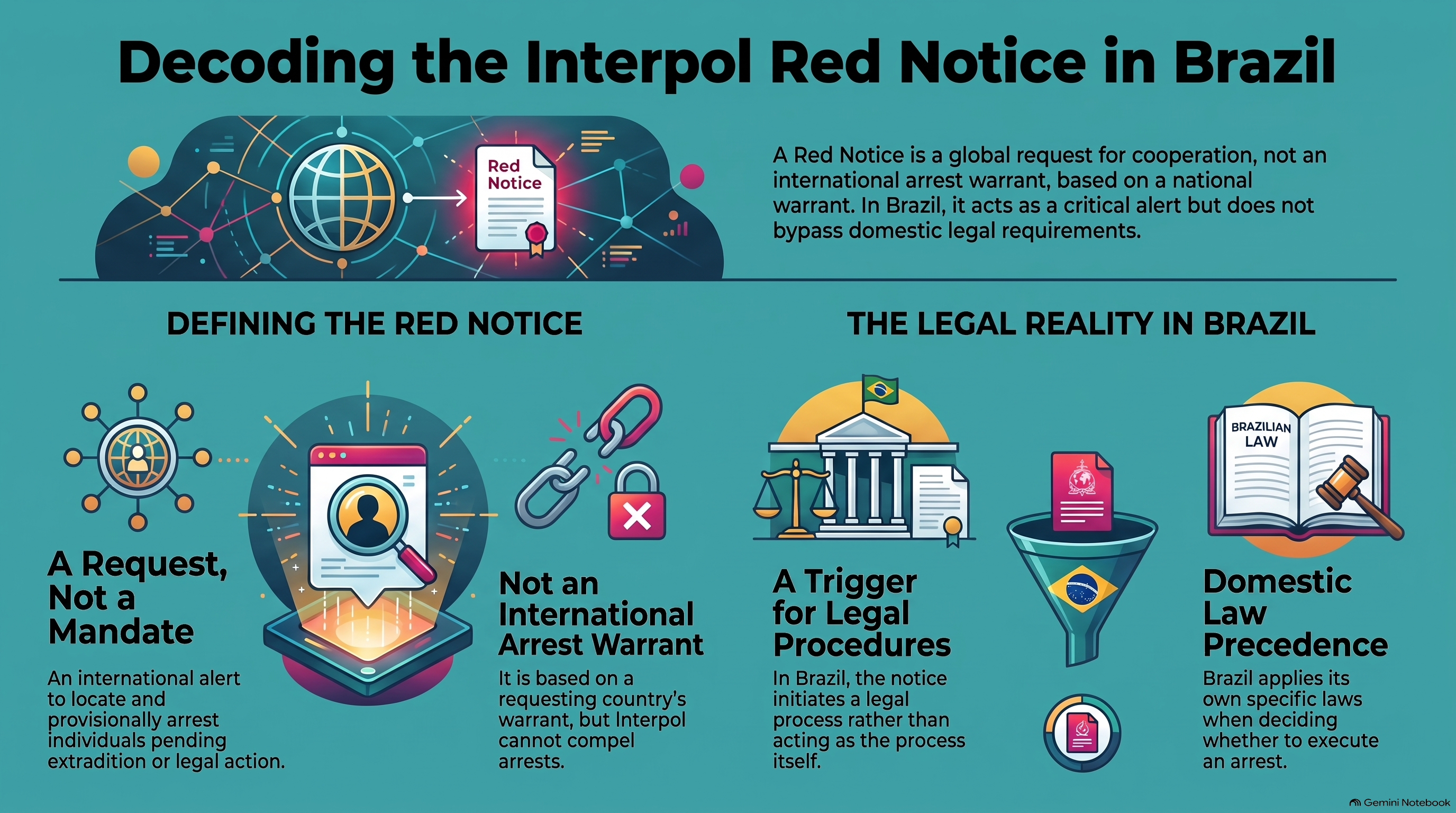
No. According to INTERPOL, a red notice is a request to law enforcement worldwide to locate and provisionally arrest a person pending extradition, surrender or similar legal action, and it is not an international arrest warrant. INTERPOL states that the notice is based on an arrest warrant or court order issued by the judicial authorities of the requesting country, and that member countries apply their own laws in deciding whether to arrest.
The organisation also states that the individuals concerned are wanted by a country or an international tribunal, not by INTERPOL, and that it cannot compel any country to arrest them. In Brazil, the alert is what triggers a legal procedure; it is not the procedure itself.
Am I presumed guilty if my name is on an Interpol red notice?
No. According to INTERPOL, a person sought for prosecution has not been convicted and should be considered innocent until proven guilty; only where the person is sought to serve a sentence has a court in the requesting country already found them guilty. INTERPOL does not investigate the underlying case.
What is the difference between a red notice and a diffusion?
The difference is who circulates the alert. INTERPOL states that notices are issued by the General Secretariat at the request of a member country's National Central Bureau and made available for all member countries to consult in the notices database, while a diffusion is circulated directly by a National Central Bureau to all or some other member countries. Wanted-person diffusions, like red notices, are checked for compliance by INTERPOL's Notices and Diffusions Task Force, a specialised team of lawyers, police officers and operational specialists. Neither is a public document by default: INTERPOL states that the majority of red notices are restricted to law enforcement use only, and a diffusion travels only between national bureaux, so the alert against you may exist without appearing on any public page.
- Red notice: published by INTERPOL's General Secretariat at a country's request and consultable by all member countries. It does not, by itself, authorise an arrest in Brazil.
- Red diffusion: sent directly by one National Central Bureau to other bureaux, also subject to compliance review. It likewise does not, by itself, authorise an arrest in Brazil.
- Brazilian judicial order: the only instrument that authorises detention here, issued under art. 84 of the Migration Law after the Federal Prosecution Service has been heard.
Can the Federal Police arrest you in Brazil just because of a red notice?
Not on the alert alone. Under art. 84 of the Migration Law (Lei 13.445/2017), a State interested in an extradition may, in urgent cases, request a precautionary arrest through diplomatic channels or through the central authority of the Executive Branch; that Brazilian central authority then examines the formal admissibility requirements and applies to the competent judicial authority, with the Federal Prosecution Service heard beforehand.
In passive extradition, that competent judicial authority is the Federal Supreme Court (Supremo Tribunal Federal — STF). Art. 90 of the Migration Law provides that no extradition is granted without a prior ruling by the Federal Supreme Court on its legality and merits, and art. 86 places the decision on custody in the hands of the same Court. The Interpol channel is expressly contemplated and does not shortcut that judicial step: art. 84, §2 allows the request to be transmitted to the competent Brazilian authority through the channel established with the country's Interpol focal point, supported by documents proving the foreign arrest order and, where there is no treaty, by a promise of reciprocity received through diplomatic channels.

How long can you be held before the foreign country files its extradition request?
Sixty days. Under art. 84, §4 of the Migration Law, absent a specific treaty provision, the foreign State must formalise the extradition request within 60 days from the date it was notified of the arrest. Art. 84, §5 provides that, if the request is not filed in time, the person must be released, and no new precautionary arrest may be sought on the same facts unless the extradition has been duly requested. Once the request does arrive, the clock changes character rather than stopping: art. 84, §6 allows the precautionary arrest to be extended until the competent judicial authority rules on the legality of the request.
- Day zero: the precautionary arrest is ordered by the competent judicial authority under art. 84, after the Federal Prosecution Service has been heard.
- From notification of the arrest: the requesting State has 60 days to formalise the extradition request (art. 84, §4).
- If nothing is filed: release is mandatory, with no fresh precautionary arrest on the same facts (art. 84, §5).
- If the request is filed: custody may continue until the ruling on its legality (art. 84, §6), and the case proceeds to interrogation and defence.
Can you wait for the extradition case out of custody?
It is legally possible. Art. 86 of the Migration Law allows the Federal Supreme Court, after hearing the prosecution, to authorise open or house arrest, or to determine that the person answer the extradition proceeding at liberty, with retention of the travel document or other necessary precautionary measures, until the extradition is judged or the person is surrendered. The same provision states what the court weighs: the person's administrative migration status, their record and the circumstances of the case. That is why proof of a stable life in Brazil (lawful residence, address, employment, family) belongs in the file from the start, not after the first decision on custody.
Will a red notice stop you from entering Brazil or renewing your visa?
It can. Art. 45, III of the Migration Law allows entry to be refused, after an individual interview and by reasoned decision, to a person convicted or facing proceedings in another country for an intentional crime subject to extradition under Brazilian law. Art. 45, IV covers a person whose name appears on a restriction list by court order or by a commitment Brazil assumed before an international body. The effect reaches visas as well: under art. 11, a visa may be denied to a person falling under items I, II, III, IV or IX of art. 45, and its sole paragraph provides that a person whose Brazilian visa has been denied is barred from entering while the conditions that led to the denial persist.
Does a red notice cancel your Brazilian residence permit?
The Migration Law does not list an Interpol alert as a ground for automatic cancellation of a residence authorisation already granted. What art. 34 provides is that a residence authorisation may be denied on the grounds set out in items I, II, III, IV and IX of art. 45, which is why a pending renewal is more exposed than a valid permit.
Can Brazil deport or expel you instead of extraditing you?
These are three different measures and one cannot be substituted for another. Deportation, under art. 50 of the Migration Law, is an administrative measure for a person in an irregular migration situation, preceded by personal notification and a period of no less than 60 days to regularise. Expulsion, under art. 54, follows a final conviction for the offences listed there. Extradition surrenders a person to a foreign State that claims them for a crime committed abroad. Brazilian law closes the shortcut expressly: art. 53 provides that deportation shall not proceed where it would amount to an extradition not admitted by Brazilian law, and art. 55, I sets the same bar for expulsion.
Does having a Brazilian spouse or child stop the extradition?
No. Súmula 421 of the Federal Supreme Court, approved at the plenary session of 1 June 1964, states that being married to a Brazilian or having a Brazilian child does not prevent extradition, and the Court has repeatedly held the enunciation compatible with the 1988 Constitution in cases of cooperation against ordinary crime. Family ties may weigh on custody conditions; they are not a defence to surrender.
What should you do in the first 48 hours after being detained on an Interpol alert?
Four things, in this order. Appoint a criminal defence lawyer in Brazil immediately. Ask the authority to notify your consulate. Obtain the case reference and the identity of the requesting country, because the deadlines run from the notification of the arrest. Gather migration documents, proof of address and employment records, since art. 86 of the Migration Law makes them relevant to any decision on custody.
The reason for the speed is procedural. Under art. 91 of the Migration Law, the reporting justice sets a date for the interrogation of the person sought, and art. 91, §1 gives ten days from that interrogation to file the defence, which may address only the identity of the person claimed, a defect in the form of the documents, or the illegality of the extradition. Art. 4, IX guarantees migrants broad access to justice and full free legal assistance to those who prove insufficient means.
An Interpol alert is not a conviction, and the lawful answer to one is not to leave Brazil, change address without notice or fail to appear. The legal routes are the ones described above: contest the alert before the Commission for the Control of INTERPOL's Files, defend yourself in the extradition proceeding, and appoint counsel in Brazil.
Do you have the right to contact your consulate if you are detained in Brazil?
Yes. Under art. 36, paragraph 1(b) of the Vienna Convention on Consular Relations, promulgated in Brazil by Decree 61.078/1967, a detained foreign national may request that the consular post of their country be informed of the detention, and the authorities must inform the person of that right without delay.
This article provides general legal information on Brazilian law and is not legal advice for a specific case. Every situation depends on the applicable treaty and on the facts, and should be assessed by a lawyer.
Why an extradition case in Brazil needs a Criminal Law specialist from the first hour
Deadlines in an extradition proceeding are short, non-renewable and triggered by an event you do not control. Leticia Bittencourt Carvalho Bernardes heads the Criminal Law practice at Garrastazu Advogados. The team works with Interpol alerts and extradition requests involving foreign nationals in Brazil, and also assists clients with custody hearings, precautionary measures and migration-related criminal matters. With specialists across every area of law and online service throughout the country, Garrastazu Advogados is ready to assess your case. Get in touch.

Frequently Asked Questions
Who actually orders an arrest for extradition purposes in Brazil?
A court does, and in passive extradition it is the Federal Supreme Court. Art. 84 of the Migration Law requires the Brazilian central authority to examine the formal requirements and then apply to the competent judicial authority, with the Federal Prosecution Service heard beforehand. The Federal Police act on the judicial order, not on the alert.
Does Brazil need an extradition treaty before it can arrest me?
No. Art. 84, §2 of the Migration Law expressly contemplates a precautionary arrest request supported, where there is no treaty, by a promise of reciprocity received through diplomatic channels. Where a treaty applies, it prevails on the points it regulates.
Can I be extradited if I am already facing charges in Brazil?
Not immediately. Art. 95 of the Migration Law provides that, where the person is being prosecuted or has been convicted in Brazil for an offence punishable by imprisonment, the extradition is executed only after the case ends or the sentence is served, subject to the exceptions listed there.
Is there any appeal against the Federal Supreme Court's decision on extradition?
No. Art. 90 of the Migration Law states that no extradition is granted without a prior ruling by the Federal Supreme Court on its legality and merits, and that no appeal lies against that decision.
If the extradition is refused, can the same country request it again?
Not on the same facts. Art. 94 of the Migration Law provides that, once extradition has been denied in the judicial phase, no new request based on the same fact is admissible.
Can I check the public Interpol website to find out if there is a red notice against me?
An empty search proves nothing, because INTERPOL states that the majority of red notices are restricted to law enforcement use only. INTERPOL indicates that you can contact the Commission for the Control of INTERPOL's Files, an independent body, and that applications to it are free of charge and treated confidentially.
Can I be held in custody in Brazil simply because my migration status is irregular?
No. Art. 123 of the Migration Law provides that no one shall be deprived of liberty for migration reasons except in the cases the law itself sets out. An irregular status leads to a deportation procedure with a period to regularise, not to detention.
Content reviewed in September 2026, based on the legislation in force.



Fique por dentro das nossas novidades.
Acompanhe nosso blog e nossas redes sociais.